Research
How do developmental history and gene regulation shape the diversity of inhibitory neurons?
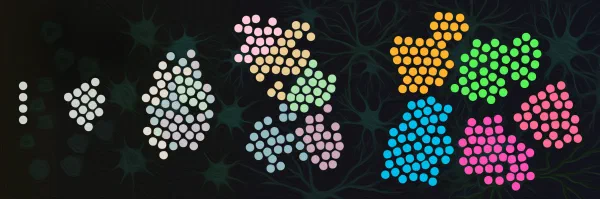
Many inhibitory neurons of the forebrain originate in the ganglionic eminences, transient regions of the embryonic brain. Progenitors in these regions generate both local interneurons and GABAergic projection neurons, including those of the striatum. We study how related progenitors give rise to different neuronal identities, primarily in the developing mouse forebrain.
Our approach connects lineage, a cell’s developmental ancestry, with its molecular state and the effects of genetic perturbation. Cell-type proportions alone cannot reveal how individual progenitors contribute to neuronal diversity. By measuring lineage alongside gene expression, we can test how developmental history and regulatory mechanisms shape the cells that are produced.
Current research
Gene regulation and neuronal identity
How do transcription factors work together at enhancers, the DNA elements that regulate gene activity? We combine computational predictions of regulatory networks, biochemical analysis of protein complexes and genetic perturbation to identify mechanisms that influence early neuronal fate decisions. This work is supported by the Deutsche Forschungsgemeinschaft (2025–2028).
Florian Neuhaus and Ann Rose Bright are developing enhancer assays that link reporter activity to the molecular state of individual cells. We are also developing an approach to combine these measurements with predictive sequence models. The aim is to design new enhancers and test how sequence features influence activity in particular developmental cell states.
Timing and stability of cell fate
When does a developing neuron become committed to a particular identity? Ann Rose Bright is adapting and validating reversible CRISPR interference for use in the developing mouse brain. This approach is intended to suppress a regulator during a defined developmental window and then restore its expression, allowing us to test how the timing and duration of a perturbation affect cell fate.
Seline Partsch works with Ann Rose Bright on developing and validating this approach as part of her master’s thesis.
Chromatin regulation in neurodevelopmental disorders
Many genes associated with neurodevelopmental disorders regulate gene expression. Elena Dvoretskova is investigating ASH1L and SETBP1, two regulators linked to autism risk, to understand how their disruption affects inhibitory neuron development. We ask which developmental cell states and regulatory elements are affected, and how these changes influence neuronal identity and maturation.
This work is supported by SFARI (Simons Foundation) and the Nancy Lurie Marks Family Foundation (2025–2027).
Developmental origins of circuit connectivity
How does a neuron’s developmental history relate to the inputs it receives? Connor Lynch, working with Rachel Bandler at Yale, combines barcoded monosynaptic rabies tracing with bioinformatic analysis of single-cell data to characterise the input connectivity of the prefrontal cortex by cell type. This work provides a basis for investigating how developmental perturbations influence later wiring.
The method, RabV-seq, was developed with Karl-Klaus Conzelmann at LMU and is currently unpublished.
Selected contributions
These findings from the group and Christian Mayer’s earlier research provide the basis for our current questions.

Lineage and neuronal diversity. Clonally related interneurons can disperse across distinct forebrain regions, showing that shared ancestry does not imply a shared anatomical destination (Mayer et al., 2015). Later, TrackerSeq linked clonal ancestry to molecular identity and showed that individual progenitors can produce diverse GABAergic neuron types, with divergence detectable around cell-cycle exit (Bandler et al., 2022).
The emergence of interneuron identities. A developmental single-cell atlas traced how early progenitor programmes give rise to increasingly distinct interneuron identities after cell-cycle exit. The study identified MEF2C as a marker and requirement for the developing parvalbumin lineage (Mayer et al., 2018).
Transcription factor partnerships. We showed that MEIS2 and DLX5 cooperate to activate projection-neuron enhancers, while LHX6 represses their activity in interneuron precursors. A MEIS2 variant associated with intellectual disability reduced this cooperative activation (Dvoretskova et al., 2024). In a subsequent preprint, we investigate how the relative levels of SP9 and DLX influence regulatory activity and GABAergic neuron subtype production (Dvoretskova et al., 2026).
Developmental timing and maturation. We distinguished progenitors’ capacity to generate different neuronal identities from their capacity to shape the maturation of their progeny. In the mouse ganglionic eminences, these properties showed different temporal dynamics, with chromatin regulation and NFIB contributing to maturation competence (Bright et al., 2025).
Methods and analysis
We developed TrackerSeq to read heritable lineage barcodes alongside single-cell transcriptomes. tCROP-seq measures the effects of targeted CRISPR perturbations in the developing brain and can be combined with TrackerSeq to connect perturbation, ancestry and molecular state in the same cells.
These approaches are complemented by chromatin profiling, birthdating, transplantation, enhancer reporter assays and biochemical analysis. We develop computational analysis alongside the experiments, including the TrackerSeq pipeline for assigning barcodes to cells. In collaboration with Peter Kharchenko and Igor Adameyko, we also apply clone2vec, a method developed in their laboratories for comparing whole clones.